
Treatment guides
The History of NAD+
From yeast experiments in 1906 to modern cellular research, explore the discoveries that shaped our understanding of NAD+.
By Zoya Editorial · October 21, 2026 · 4 min read
Educational, not medical advice. Published by Zoya, not an independent review.
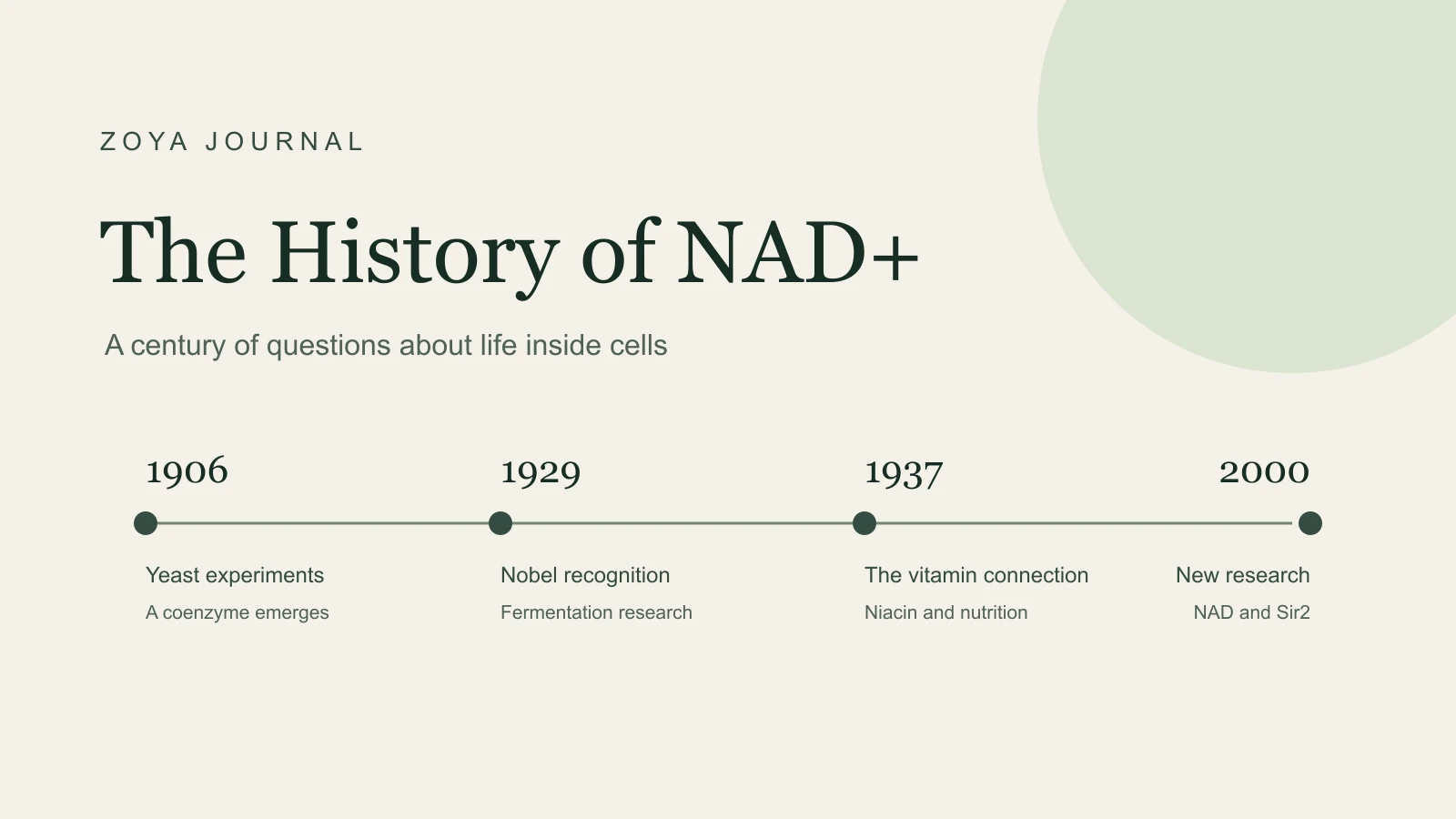
La revista de Zoya
La historia del NAD+
Un siglo de preguntas sobre la vida celular
1906
Levadura y coenzimas
1929
Reconocimiento Nobel
1937
Niacina y nutrición
2000
NAD y Sir2
Long before NAD+ appeared in conversations about wellness, it was part of a much older scientific puzzle: how do living cells turn food into the energy they use?
The answer emerged through experiments with yeast, studies of nutrition, and research into the chemistry inside cells. Following that history helps explain what NAD+ is, why scientists study it, and why a molecule's importance in biology is a different question from what a particular treatment can achieve.
What does NAD+ stand for?
NAD stands for nicotinamide adenine dinucleotide. It is a coenzyme: a small molecule that helps enzymes carry out chemical reactions. The plus sign identifies its oxidized form. When it accepts electrons during a reaction, it becomes NADH.
This back-and-forth is part of the chemistry cells use to process nutrients. NAD is also involved in other cellular activities, including enzymes that help maintain genetic material and regulate gene expression. The NIH Office of Dietary Supplements describes these roles in its niacin fact sheet.
1906: a clue in yeast experiments
Arthur Harden and William John Young were investigating fermentation, the process by which yeast converts sugar into alcohol and carbon dioxide. Their experiments revealed that the reaction needed something beyond the enzymes researchers were studying.
They identified a small, heat-stable component that could pass through a dialysis membrane. It helped fermentation proceed even though it was distinct from the larger enzyme machinery. The substance became known as cozymase, later identified with NAD. Their work established an early example of a coenzyme helping an enzyme system function.
Harden described the experiments in his Nobel lecture on fermentation. The discovery began with a laboratory observation about yeast, opening a route toward understanding a process shared across living systems.
1929: fermentation research earns a Nobel Prize
The 1929 Nobel Prize in Chemistry went jointly to Harden and Hans von Euler-Chelpin for their investigations of sugar fermentation and fermentative enzymes.
Von Euler-Chelpin helped advance understanding of cozymase's chemical structure. Together, these lines of research moved the field from observing that an unknown helper was necessary toward identifying what that helper was.
NAD+'s history is therefore a sequence of discoveries. Finding a substance, working out its structure, and explaining its function are separate steps, often involving different researchers.
The 1930s: cellular chemistry meets nutrition
Another strand of the story concerned vitamin B3. In 1937, Conrad Elvehjem and colleagues reported work on nicotinic acid and nicotinamide in canine black tongue, a nutritional deficiency disease studied in dogs.
That research belongs to the history of niacin and deficiency disease. The biochemical connection is that the body uses niacin to make NAD. What people eat and how cells carry out essential reactions were becoming parts of the same scientific picture.
The names can be confusing: nicotinic acid and nicotinamide are forms of vitamin B3. They should not be confused with nicotine. NAD is the coenzyme that the body can produce from these nutritional building blocks.
2000: a new connection to gene regulation
Research later expanded beyond NAD's role in energy metabolism. In a 2000 study published in Nature, Shin-ichiro Imai and colleagues showed that the yeast protein Sir2 had NAD-dependent histone deacetylase activity.
In everyday language, their experiments linked NAD to an enzyme involved in how genetic material is regulated. This helped connect questions about metabolism with questions about gene silencing and aging in experimental systems.
The setting matters. A finding about yeast proteins establishes a biological mechanism; it does not, by itself, establish that giving NAD+ to people produces a particular health outcome.
Why this history still matters
NAD+ was studied for decades before today's public interest in it. Its story shows how science builds understanding through specific, testable questions: what does a reaction require, what is the missing molecule, and what does it do?
Those questions remain useful when reading about NAD+ today. Understanding a molecule's normal role is a foundation for research. Establishing the effects of a supplement or medical intervention requires its own evidence.
For more educational articles from Zoya, visit the Journal.
Sources
- Arthur Harden: Nobel lecture, Fermentation of Sugars and Fermentative Enzymes.
- Nobel Prize in Chemistry, 1929.
- Elvehjem and colleagues: Relation of Nicotinic Acid and Nicotinic Acid Amide to Canine Black Tongue, 1937.
- Imai and colleagues: Transcriptional silencing and longevity protein Sir2 is an NAD-dependent histone deacetylase, 2000.
- NIH Office of Dietary Supplements: Niacin.
Explore NAD+ pricing and plan options at Zoya.
Check the linked sources and verify current prices, availability, and policies before making a purchase. Provider names identify the services discussed and do not imply affiliation or endorsement. Clinical decisions belong to licensed healthcare providers.
Compounded drugs are not FDA-approved.
Clear terms. Your next step.
Explore the pharmacy options and package details available through Zoya. A licensed clinician determines whether treatment is appropriate.
See current pricing ↗Keep exploring
More clarity, this way.

Treatment guides
Tirzepatide vs. semaglutide: what actually matters when choosing care
Understand the differences between the two medications, then compare clinical care, plan terms, and pharmacy options without relying on a headline alone.
4 min read

Provider comparisons
Zoya vs. Lavender Sky Health: package pricing and pharmacy choice
Compare dose-tiered packages, covered periods, pharmacy availability, and the difference between a monthly average and a monthly payment.
3 min read

Pricing & planning
GLP-1 costs: monthly plans, 12-week packages, and the real total
Learn to compare the amount due, weeks covered, dose tiers, shipping, and financing so a low monthly headline does not hide a different purchase.
4 min read